$PYONYA
Durov's dog. A sticker pack created by Durov himself.
Now a meme coin on TON — built from the original Telegram lore.
EQAOyf4n-7wTtTI45LGQwfacEfnkpOa9v6bjpwgeCHX5WW8y
Copied!

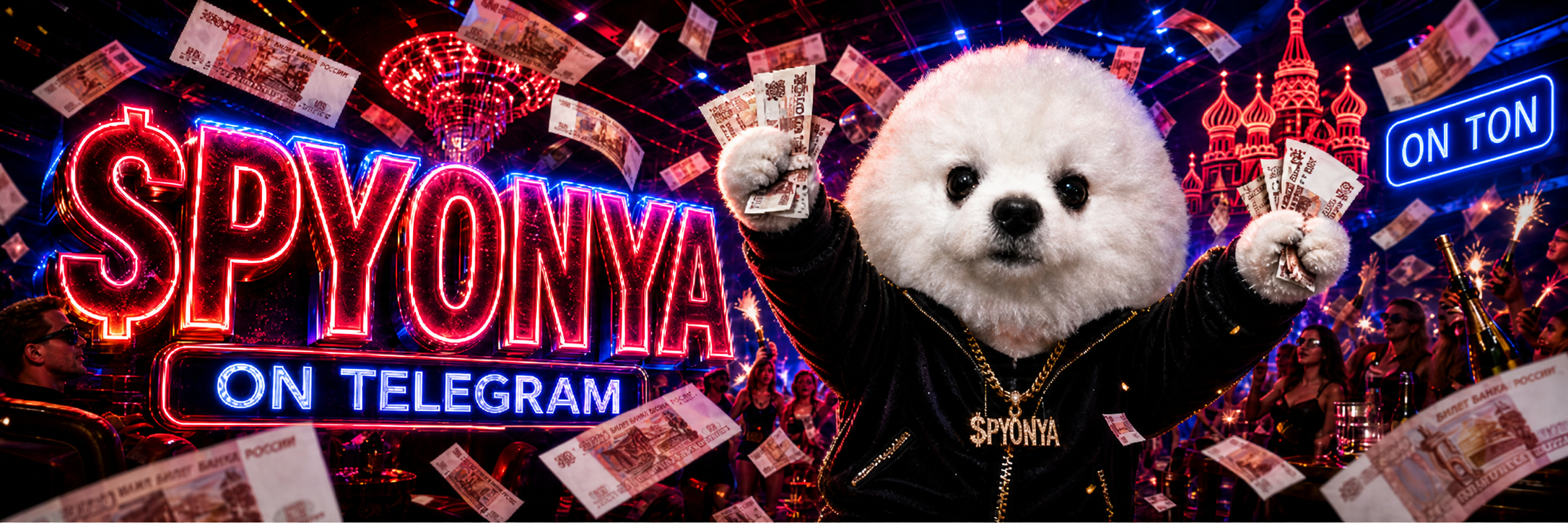
The Dog Behind The Mask?
Before $PYONYA ever appeared on a blockchain, before it had a chart or a contract address, Pyonya was something else entirely. Pyonya was a name that floated through the earliest layers of Telegram culture — whispered in sticker pack archives, buried inside bot metadata, and carried forward by a small but persistent group of people who remembered where it came from.
The story, as the community understands it, begins with Pavel Durov himself. Old Telegram archives describe Pyonya as a sticker pack that was created by Durov — not by a third-party designer, not by a random contributor, but by the founder of Telegram personally. The pack was filled with images of a small, fluffy white dog. According to conversations that have circulated within the community for years, this dog was not just a random illustration. Community lore holds that Pyonya was Durov's actual dog — a real animal that was known to be around the Telegram office, present during the early days of the platform's development, and familiar to the people who worked alongside Durov during that era.
That detail — the idea that this fluffy little dog was physically present in the Telegram office, walking around the same rooms where one of the world's most important messaging platforms was being built — is what separates the Pyonya story from every other meme coin narrative. This is not a character that was invented for a token launch. This is a dog that, according to the lore, existed in a very specific place and time, and whose likeness was personally turned into a sticker pack by one of the most significant figures in the history of encrypted communication.
After the $PYONYA token launched on TON, the community started pulling on every thread they could find. Sticker receipts, Telegram Dictionary entries, bot metadata, old social media posts, REDO mask theories, and public screenshots all became part of the same expanding investigation. The lore trail grew wider and deeper with every new discovery, and the community that formed around $PYONYA became defined not just by the token itself, but by the collective effort to map the full history of where Pyonya came from.
We are not here to force the answer. The lore is the meme. The deeper you look, the more you find.
Sticker Pack Origin
The foundation of the entire $PYONYA narrative rests on a single, verifiable fact: a sticker pack named Pyonya existed on Telegram. Not recently — not in response to a token launch or a trending topic — but years before any of this became a meme coin conversation. The Pyonya sticker pack was part of Telegram's early sticker ecosystem, a curated set of images featuring a small, fluffy white dog in various poses and expressions.
What makes this particular sticker pack significant is its attributed origin. According to the Telegram Dictionary and community archives, the Pyonya pack was created by Durov himself. In the early days of Telegram, Durov was known to personally create and contribute sticker packs to the platform. The Pyonya pack, filled with images of what the community widely assumes to be his own dog, represents one of those personal contributions — a direct creative artifact from the founder of Telegram, embedded into the platform's culture from the very beginning.
Community members who have traced the history of Telegram sticker packs point to the Pyonya pack as one of the earliest examples of Durov using the sticker system to share something personal. The dog in the images is not a cartoon. It is not a stylized mascot. It appears to be a real, photographed animal — a fluffy white Pomeranian-type dog that, according to long-standing community conversations, was a constant presence around the Telegram office during the company's formative years. People who discussed Telegram culture in its early era described Pyonya not just as a sticker pack, but as a reference to a dog that Durov's inner circle would have recognized on sight.
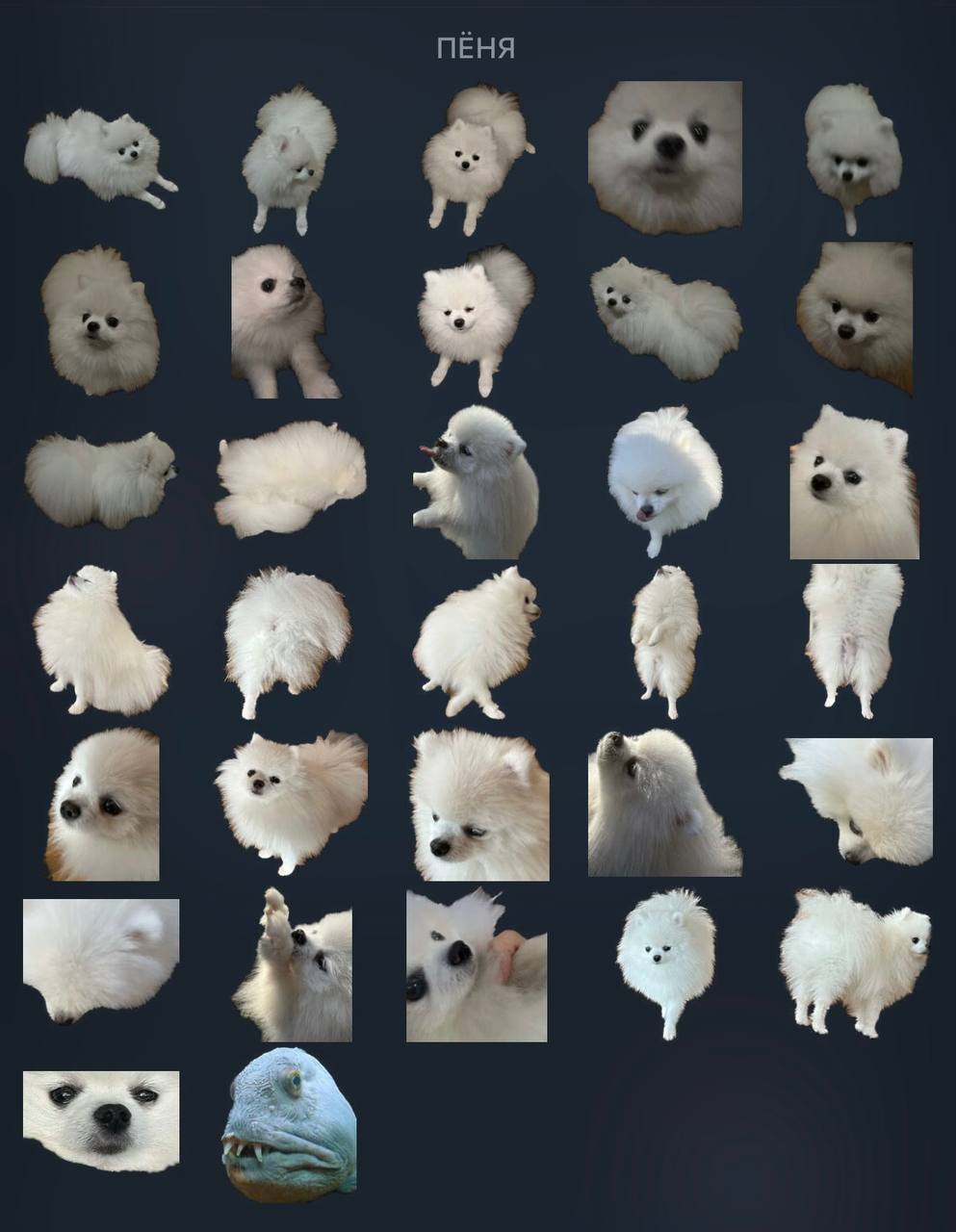 Actual Pyonya sticker pack screenshot circulated by the community.
Telegram Receipts
Of all the evidence that the $PYONYA community has compiled, the Telegram Dictionary entry stands out as one of the most concrete and widely referenced pieces. The Telegram Dictionary — an informal but well-known reference that catalogues Telegram-specific terminology, culture, and history — contains a dedicated entry for Pyonya. The definition is direct and unambiguous in its description. It reads: “A sticker pack created by Durov. The sticker pack mostly consists of different images of what is assumed to be Pavel's dog.”
That single sentence carries an enormous amount of weight within the community. It does three things at once: it attributes the creation of the sticker pack directly to Durov, it identifies the subject of the stickers as a real dog rather than a fictional character, and it connects that dog specifically to Pavel Durov's personal life. For community members who had been piecing together the Pyonya story from scattered fragments and secondhand accounts, the Telegram Dictionary entry served as a major anchor point — a written, publicly accessible confirmation that aligned with everything the lore trail had already suggested.
The significance of this entry extends beyond just confirming the sticker pack's origin. It establishes a direct, personal connection between the founder of Telegram and the character that would eventually become the $PYONYA meme. Unlike most meme coins, which are built around internet-native characters or abstract concepts, $PYONYA traces its lineage back to a real dog that was part of Durov's life and that he cared enough about to immortalize in one of Telegram's earliest sticker packs.
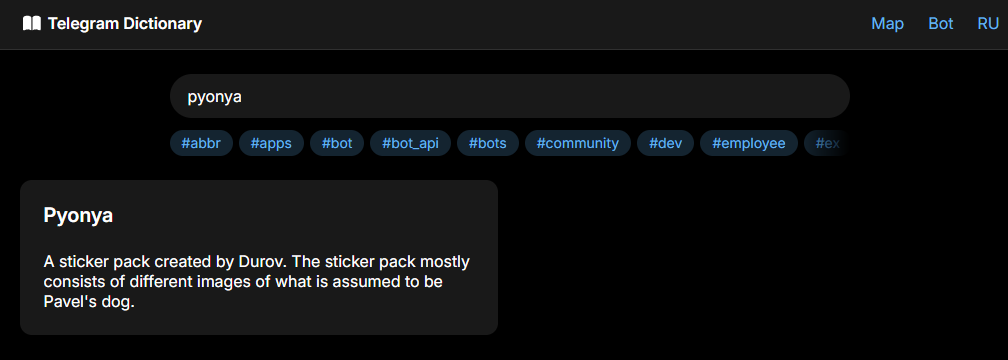 Telegram Dictionary entry for Pyonya.
Beyond the dictionary entry, the community also uncovered Telegram bot metadata that is tied to the Pyonya sticker pack. This metadata — which includes creator information, associated usernames, message interaction data, and sticker-specific technical details — provides an additional layer of documentation around the pack's history and provenance. The screenshot below shows a portion of this metadata as it was pulled and shared by community researchers.
While bot metadata alone does not constitute definitive legal proof of anything, within the context of the broader lore trail, it serves as one of the core receipts that the community uses to trace the Pyonya sticker pack back to its origins. Each piece of metadata adds texture to the story — old usernames that predate the current era, creation timestamps that place the pack firmly in Telegram's early history, and interaction patterns that suggest the stickers were part of the platform's organic culture rather than something manufactured after the fact.
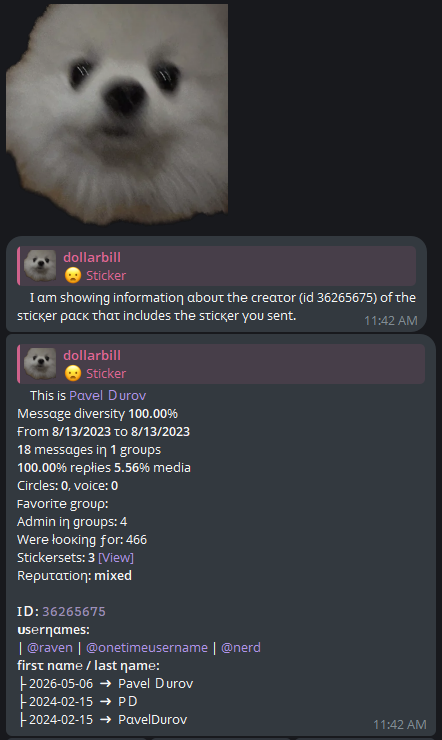 Telegram bot metadata receipt tied to the Pyonya sticker.
REDO Mask Theory
After the $PYONYA token launched and the community began its deep dive into the lore, a separate but interconnected theory started to gain traction. The question was simple, and once it was asked, it became impossible to ignore: what if the dog behind the mask was Pyonya?
The theory centers around $REDO, another token in the TON ecosystem that features a masked dog as its central character. The $REDO imagery shows a dog concealed behind a dark hood or mask — an anonymous, mysterious figure that became its own meme within the TON community. But as the $PYONYA community started comparing images, analyzing proportions, and looking at the specific characteristics of the dog visible beneath the mask, a pattern emerged. The small size, the fluffy white fur, the round face, the dark eyes — the physical features of the dog behind the $REDO mask bore a striking resemblance to the dog in the Pyonya sticker pack.
To be absolutely clear: the REDO connection is community theory, not a confirmed claim. No one has officially stated that the dog behind the $REDO mask is the same dog from the Pyonya stickers. But within the lore community, this theory became one of the strongest and most widely discussed branches of the $PYONYA narrative. The idea that Durov's own dog — the same fluffy white Pomeranian that was reportedly always around the Telegram office — might be the hidden identity behind another major TON meme added a layer of depth and mystery that no amount of marketing could manufacture.
Some community members believe the resemblance is coincidental. Others believe it is intentional. And some believe it is simply the natural result of the same dog appearing across multiple contexts within the Telegram ecosystem over the course of many years. Regardless of which interpretation any individual holds, the REDO mask theory remains one of the most compelling pieces of the $PYONYA lore puzzle — a question that is as fun to explore as it is difficult to answer definitively.
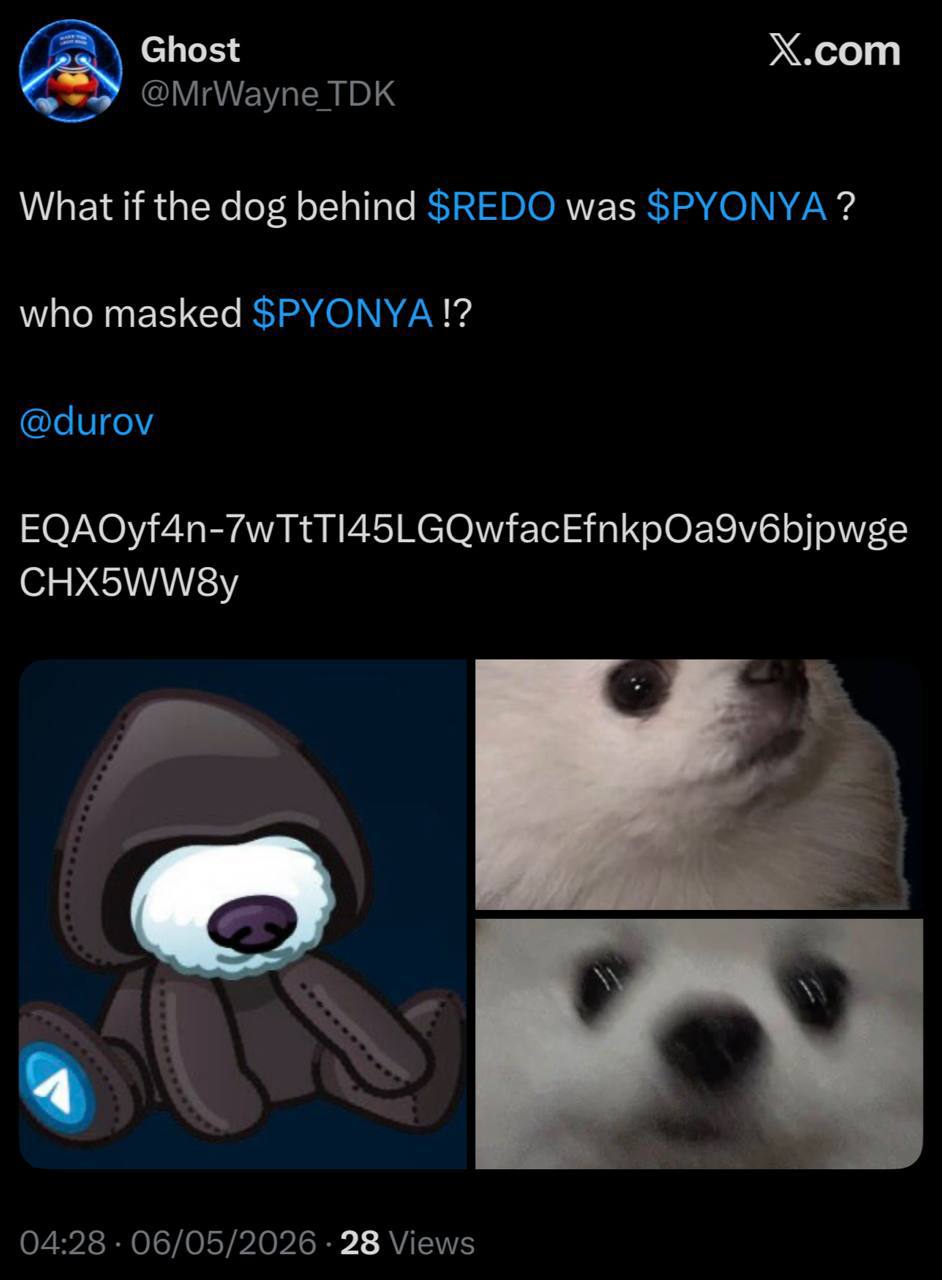 Community theory connecting $PYONYA to the masked dog narrative behind $REDO.
 Pyonya-style hooded dog comparison used by the community.
 Masked dog image compared in the $REDO theory.
The Community Found The Trail
After $PYONYA deployed on TON, something unexpected happened. The community did not just buy the token and wait for a chart to move. Instead, they started investigating. What began as casual curiosity about the sticker pack origin quickly escalated into a full-scale, decentralized research effort — one that would eventually span Telegram archives, bot metadata databases, public Instagram accounts, old social media posts, and every other digital breadcrumb that might connect back to the original Pyonya.
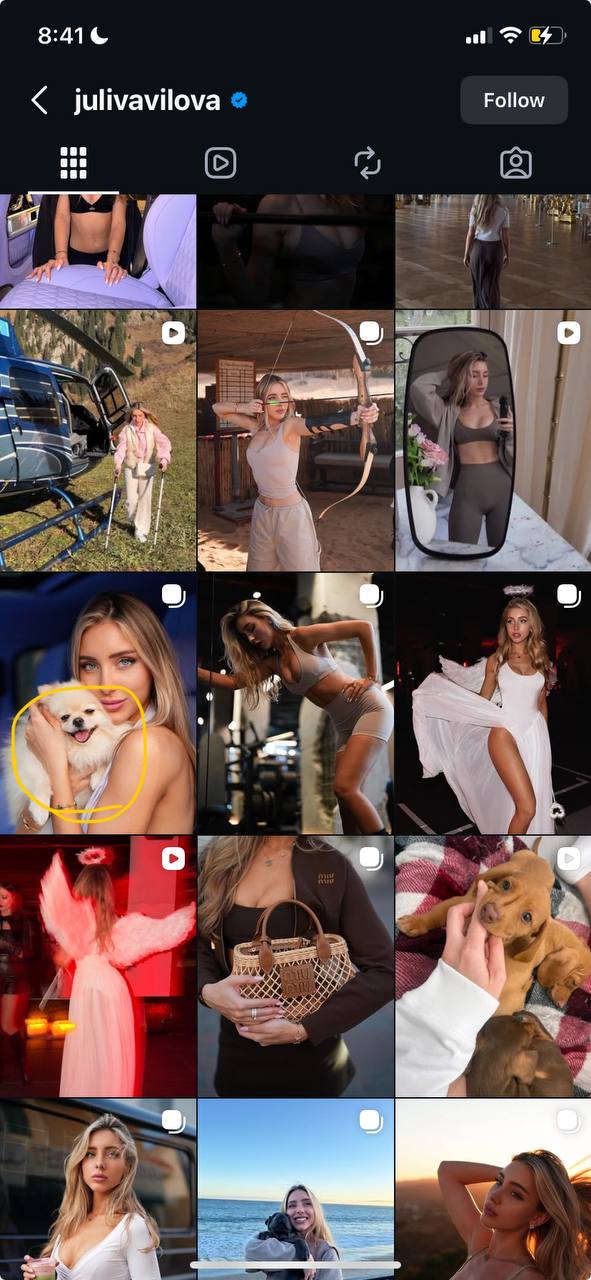
Community members found public Instagram screenshots showing a similar fluffy white dog appearing in photos associated with Telegram-adjacent people and social circles. The dog in these photos shared the same unmistakable physical characteristics as the one in the Pyonya sticker pack — the same round face, the same bright white coat, the same small frame. These were not obscure, hard-to-find images. They were public posts and stories, sitting in plain sight, that nobody had thought to connect to the Pyonya sticker pack until the community started looking.
The point of this investigation was never to force a conclusion or to make claims that cannot be verified. The point is that the deeper the community looked, the more the same little white dog kept showing up — in stickers, in metadata, in public social posts, and in the visual language of the broader Telegram ecosystem. Each new discovery added another node to the lore map, and the cumulative weight of all these connections is what gives the $PYONYA story its unique character.
This is what separates $PYONYA from the vast majority of meme coins. The lore is not a marketing strategy. The lore is a living, evolving investigation carried out by the community itself. Telegram stickers, old creator receipts, REDO mask theories, and public social breadcrumbs all feeding into the same expanding narrative — a narrative that belongs to everyone who participates in it.
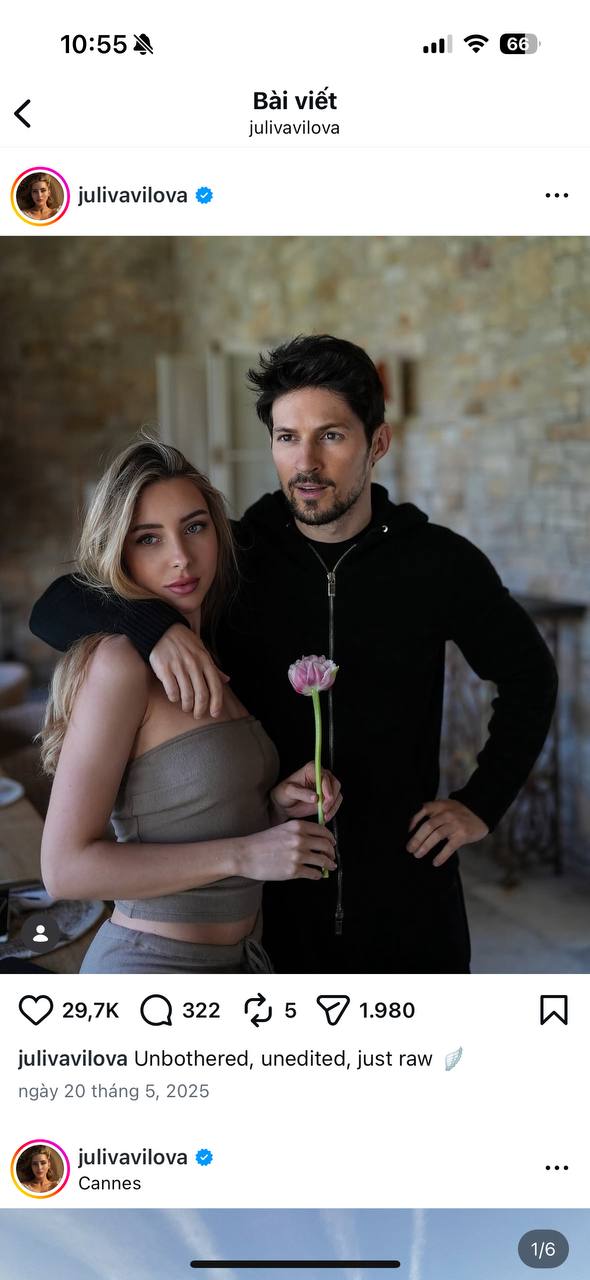 Community-found public story screenshot after deployment.
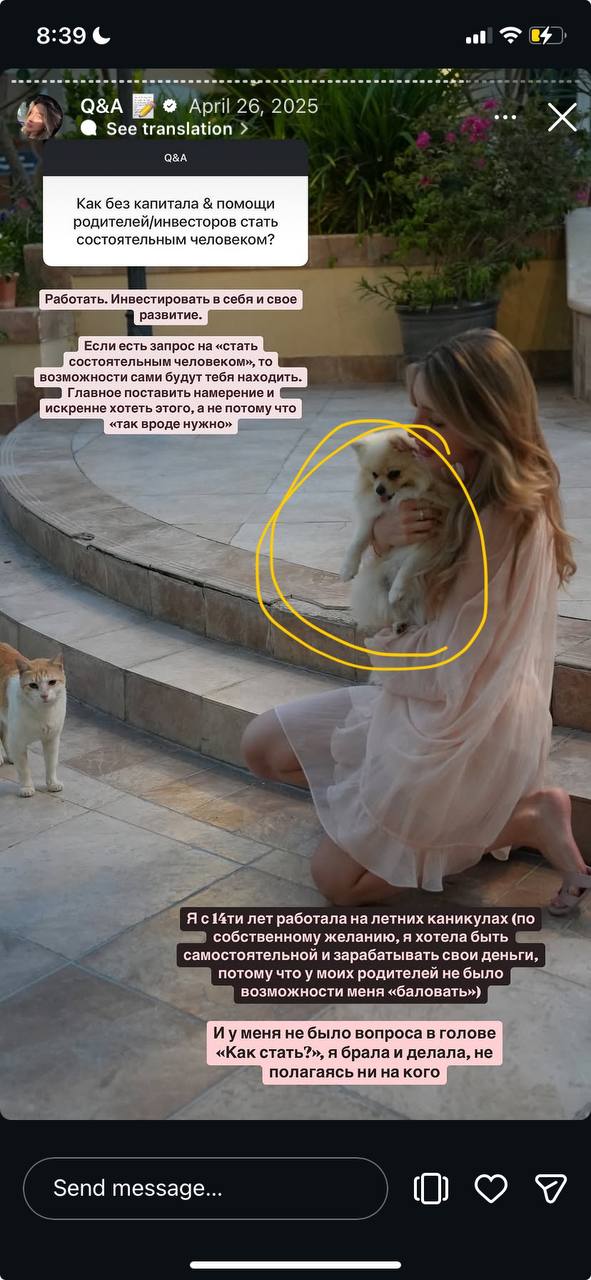 Public Instagram grid screenshot added to the lore trail.
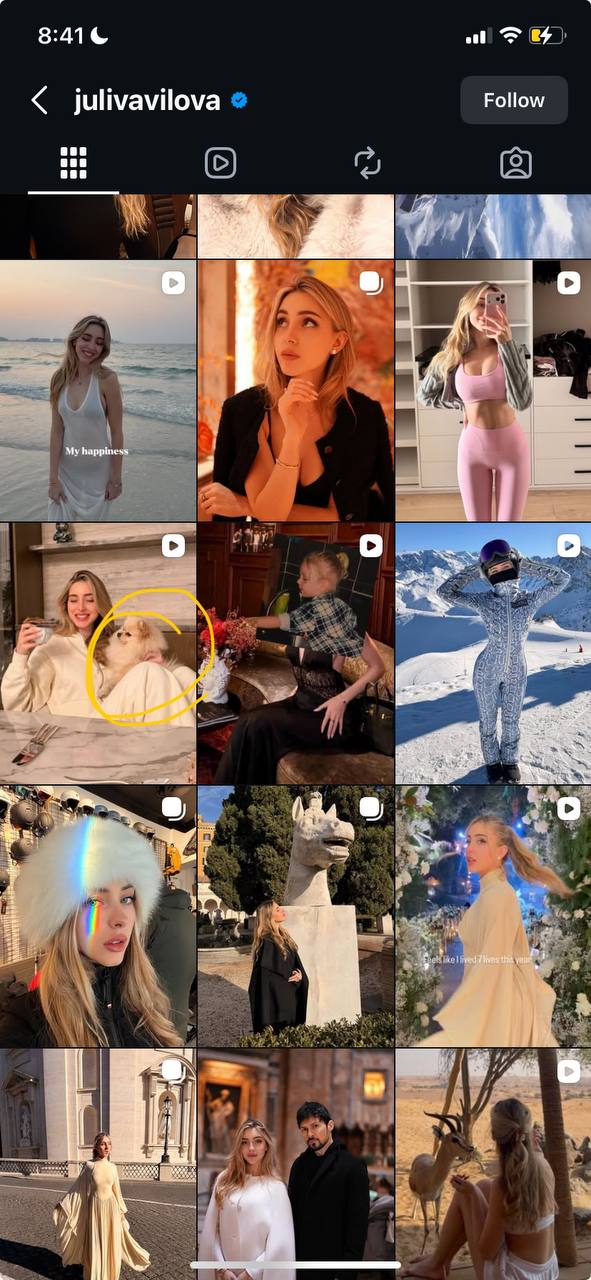 Another community-found screenshot with the same fluffy dog energy.
 Public post screenshot that became part of the $PYONYA community theory.